technology
The message of this articleThe Super RAG response strategy has a rich set of options in its design (such as automatic classification into 5 categories and a multi-hop strategy),In practical use, the focus is on mastering single-hop techniques.We are doing this. We use a chat format to ask for the next steps based on the results.It effectively covers linear multi-stage inference up to 2-3 stages.Yes, on the other hand,Processing involves branching and looping, and deep "true multi-stage inference."Regarding,This is handled through a division of labor with a specialized agent development platform.—That's the structure. This article will explain the support for this design decision.Three techniques (Dictionary preprocessing / Inline citation highlighting / Multimodal RAG Generation)Here are some areas that are implemented in the design but are currently turned off.
In the previous fifth installment, Super RAG used hybrid search and reranking.Prepare candidates that possess both meaning and vocabulary.We've explained the mechanism. Once the search results are sorted by relevance, it's time for the final hurdle—How do you construct an answer from those candidates?—That remains.
Questions asked in the workplace may look similar, but the steps required to arrive at the answer can be completely different. Some questions, like "Please explain the expense reimbursement process," can be answered by simply referring to the relevant section and summarizing the key points. Others, like "What is stipulated in the travel regulations of the company's employment rules?", can be answered by reading a specific rule or chapter. Then there are questions like "Hello," which are more naturally answered through conversation rather than by referring to a document. And then there are questions like "How is ROI (internal abbreviation for operating profit margin) treated in the regulations?"Internal terminology should be standardized first before searching.Question. Furthermore, construct the answer by looking at multiple documents.Multi-stage reasoning typeThere are also questions like this, but don't try to solve this using Super RAG alone.A design philosophy that addresses this through division of labor with a specialized agent development platform.We have adopted this (see below).
In the first and fifth installments, we introduced the "four strategies of Single-hop / Multi-hop / Direct / Dictionary" alongside each other for introductory purposes, but in this article...The current state of standard operations delivered to our customers—We will focus on a simple two-category classification (Single-hop and Direct) and the dictionary preprocessing that goes on top of it. With an eye towards integration with the agent development platform,Design decisions to perfect single-hop responses and three techniques to transform them into high-quality answers.That is the core of this article. Areas that are implemented in the design but are currently disabled will be discussed in the latter half of this article.
This is the sixth article in the series. The series is structured into five chapters: (I) Why Super RAG, (II) How to implement it, (III) Visualizing the contents, (IV) What is happening in the field, and (V) Decision on implementation. Chapter III, "Visualizing the contents," covers extraction (Part 4) → search (Part 5) → Answer Strategies (Part 6) We have covered these three main pillars. This article concludes Chapter III, and in the next article we will move on to Chapter IV, "What is Happening on the Ground."
The fourth installment isDesigned to prevent any items from being missed at the entrance.The 5th installment was "Designed to extract all captured material without any loss.If that is the case, then this article isDesigned to transform extracted information into answers that are appropriate to the question.If you read all three parts together, you will get a clearer picture of how Super RAG builds up its precision.
Internally, after the question is received,Align strategies → Rewrite using a glossary as needed → Assemble the answerThe process proceeds in this fixed sequence. The implementation for production use mainly involves a simple two-category system.
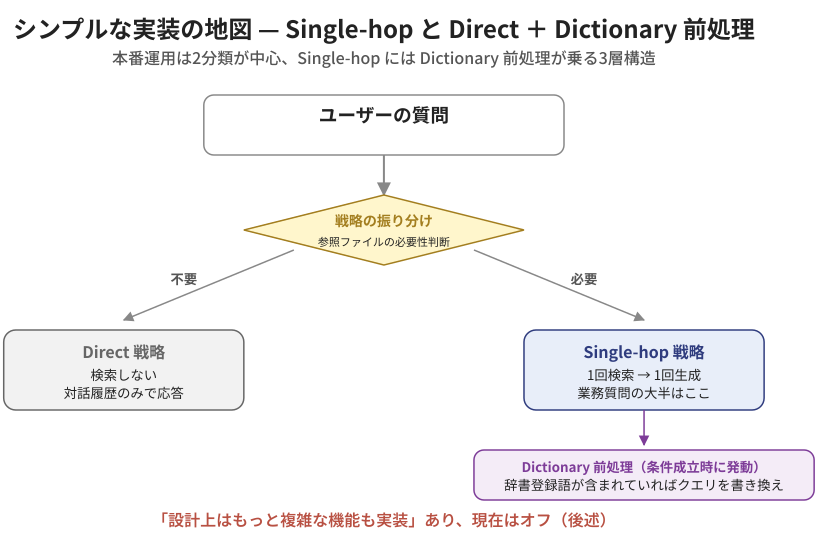
A map with a simple implementation
2Two strategiesQuestions are internally divided into the following two categories:
Dictionary Pre-treatment: In response to a question that moved on to a single-hop strategy, separate from the strategies mentioned above,If a word registered in the glossary is included in the query, rewrite the query before searching.A processing step is inserted. This is the mechanism we'll call "Dictionary preprocessing" in this article, which we promised in Part 5. DictionaryError But it starts moving here.
In other words,Based on two classifications, Single-hop and Direct, Single-hop processes undergo dictionary preprocessing.This three-tiered structure is the reality of the current standard operation.
"In the design phase, more complex structures (such as automatic classification into 5 categories and multi-hop strategies) are also implemented,"Based on internal benchmark results and market trends, these are currently off.It has been done in this way. More details will be provided later in this article.
The most common routeMost business inquiries are handled here. The process is straightforward: you submit the question to a search engine (hybrid search + reranking, as introduced in Part 5), receive a well-organized list of relevant candidates, and then LLM uses that as a basis to construct an answer in one go.
Examples of suitable questions- "Please explain the expense reimbursement process." - "What is stipulated in the travel regulations of the company's employment rules?" - "Maintenance procedures for product ABC."
Technically Azure OpenAIThe GPT model provides the answerStreamingYes. The chat call API introduced in the third installment is designed to receive this response stream and display it to the user sequentially. From the user's perspective, it is simple:When you ask a question, you get an answer with supporting evidence.That's all. The three processes that take place inside—search → prompt construction → generation—are automated processes that are invisible to the user.
In situations where the referenced file is clearly irrelevant, for exampleInteractions such as requests for calculations or requests for English translation.Therefore, there is no need to look up documents in the database. In this case, Super RAG completely skips the search process.The response will be returned based solely on the LLM dialogue history.This is a lightweight route that minimizes both search costs and latency.
Questions that have progressed to a single-hop strategy may require an additional step of processing before the search. Dictionary preprocessing For example, consider a case where "ROI" within a company refers not to the more common "Return on Investment," but to a specific "Sales ROI" (a particular sales performance indicator). If you simply search for "ROI," you might find external explanations of general ROI definitions, or you might not find any internal documents related to "Sales ROI."
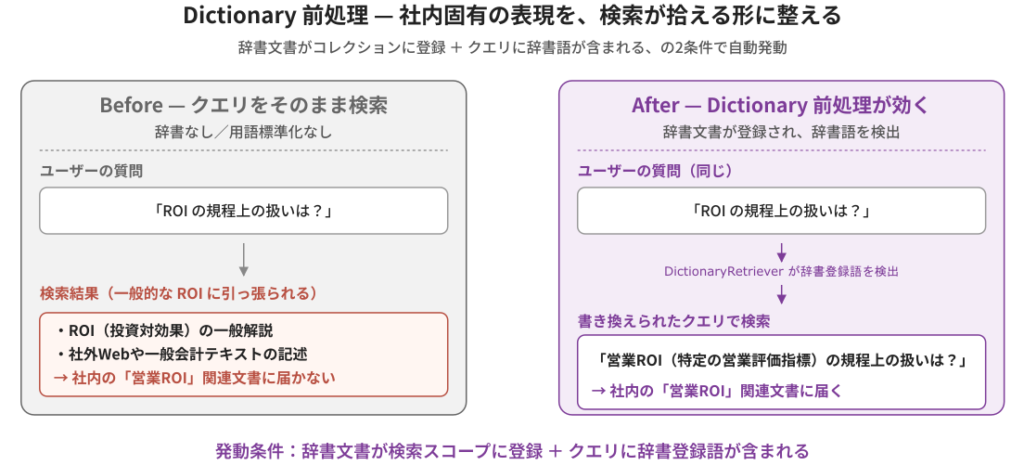
Dictionary preprocessing behavior
The conditions for triggering the Dictionary preprocessing are simple.
When these two conditions are met, it will start automatically. DictionaryError If it is checked and includedRewrite the query before searching.—The system replaces "ROI" with a more explicit form like "Sales ROI (a specific sales performance indicator)" before sending it to a regular search. It acts as a streamlining device, ensuring that company-specific expressions are properly formatted so that search queries can pick them up correctly.
In the fourth installment, we introduced the idea of "choosing chunkers according to the properties of the material (FAQChunker, DictionaryChunker, etc.)," but DictionaryChunker organizes them as "term and synonym/definition pairs," so you can look up meaningful units during the dictionary preprocessing stage.This interconnected relationship also comes into play here.
In other words,If you prepare a glossary and register the terms, Super RAG will automatically apply them.—This is a key operational characteristic of dictionary preprocessing.
Up to this point, Super RAGA map with a simple implementationWe've introduced (Single-hop and Direct + Dictionary preprocessing). You might be wondering, "Can these features alone really produce answer quality that's sufficient for business use?" From a business perspective...The quality of the response is determined not only by the number of processing strategies, but also by the ingenuity that supports those strategies.This section introduces three techniques that support the response quality of Super RAG.
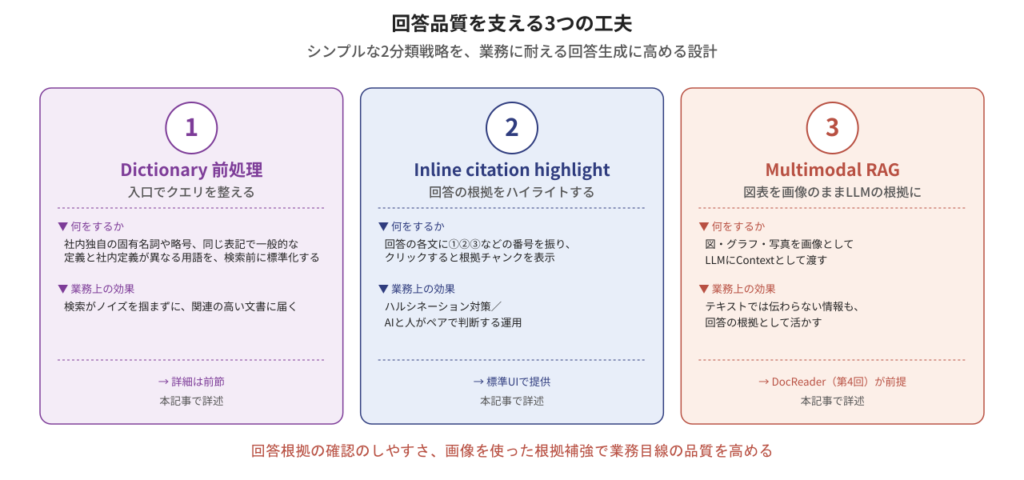
Three strategies to support the quality of your answers
The dictionary preprocessing introduced in the previous section is the first step in supporting answer quality. By standardizing questions that contain company-specific abbreviations and terminology before searching,The search engine avoids noise and delivers highly relevant documents.It will be like this.
In business use, a surprisingly large number of company-specific abbreviations (such as "ROI," "KGI," and "PKG," which have different meanings from general terms) and proper nouns like company product names are mixed in. If these are left unchecked, both vector and full-text searches will be pulled towards the "general meaning," failing to reach the documents that are actually needed within the company, or even if a search result is found, the LLM may not be able to interpret its meaning. Dictionary preprocessing plays the role of preparing queries at the entry point.
The standard UI for Super RAG includes:From which supporting chunk did each sentence in the answer come?A mechanism is incorporated to visually represent this.
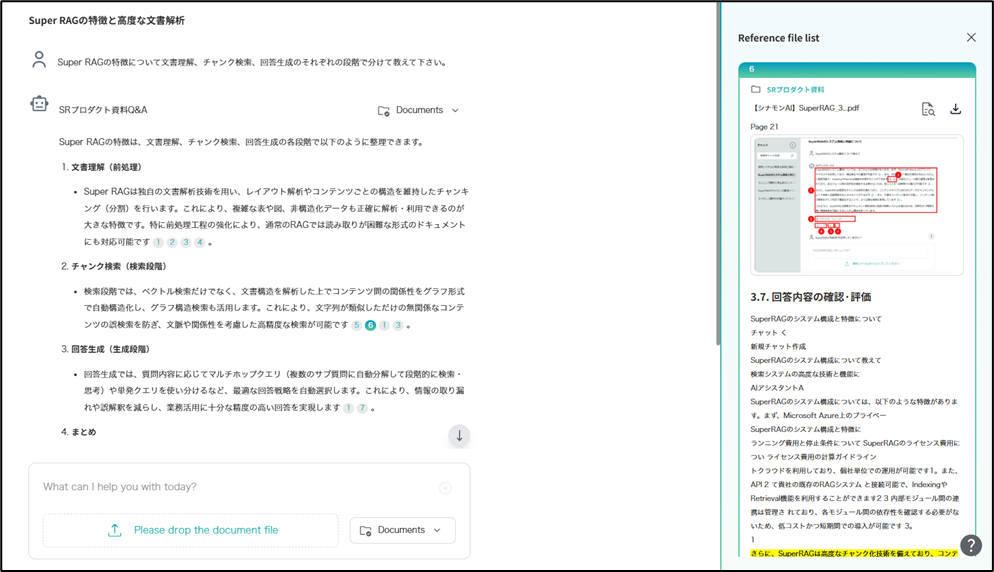
Example of inline citation highlighting
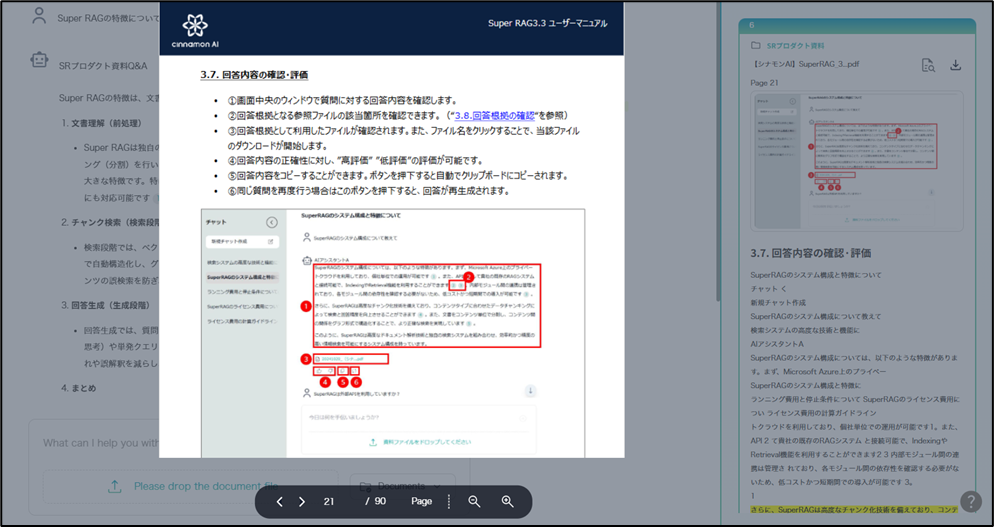
Inline citation highlighting allows you to open the original file within the app.
Specifically, in the answer text... ①②③ Numbers like this are assigned, and clicking on that number will bring up a list of reference chunks on the right side of the screen.Automatically scroll to the relevant chunk.Furthermore, if the referenced file is a document such as a PDF, Word, or PowerPoint, you can click the file icon in the upper right corner of the chunk list.The relevant section of the original file is displayed within the app.It does. This system allows you to view the data in its original appearance, while preserving the table structure and diagram layout.
Why does this directly affect the quality of the answer? When using AI answers in business,Is this information really correct?Because being able to verify "builds user trust. The user can verify the answer that the AI returns in text form."You can trace back to the supporting chunks and documents with just one or two clicks.That is,
This leads to the following effect. This is one example of how Super RAG is designed as a product that can withstand business use. Because the generated answers and their supporting evidence cannot be matched with simple strings, there are not many RAGs that allow you to cite the evidence in a way that allows you to trace it back to the original file.
In addition,This inline citation highlighting is a feature provided by the standard UI of Super RAG.That's right. While you can't retrieve this display itself via the API, the API response includes information about the supporting chunk (chunk ID, source, score, etc.), so if you're building your own UI, you'll have all the necessary materials to implement a similar display.
The third innovation is,Using the figures and tables themselves as evidence for an LLM from a document that includes them.It works.
Business documents contain a large amount of information that cannot be fully expressed through text alone. Flowcharts, organizational charts, graphs, reports with photographs, circuit diagrams, system configuration diagrams—this kind of visual information is...Converting it to text only will cause most of the meaning to be lost.In Super RAG,The system extracts charts and graphs from the original files (PDF, Office files, image files), saves them internally as image files associated with searchable text, and passes them to the LLM as context.It employs a system that allows LLM to understand text and images simultaneously.MultimodalThe system is structured in such a way that if the search results include charts or graphs, it directly reads those charts or graphs as images to generate the answer.
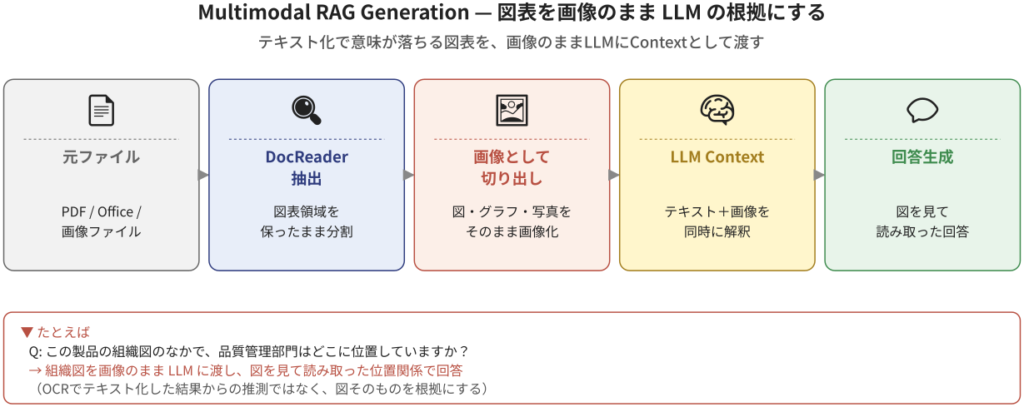
How Multimodal RAG Generation works
for example"Where is the quality control department located within this product's organizational chart?In response to the question, "If you provide the LLM with an image of the organizational chart as evidence,Answers derived from looking at the imageThis is what is returned. Instead of inferring from the result of converting to text OCR,Answer by looking at the diagram itself.—That's how it works.
This is by DocReader, which we introduced in the fourth installment.Extraction while preserving the structureThis is possible because the figure captions are linked to the text, and the figure's area is correctly extracted as an image. This allows us to place figures and tables within the context of LLM when they are included in the evidence found through a search.
The flow was: Part 4 (Extraction while preserving structure) → Part 5 (Hybrid search) → Multimodal Generation in this article.The quality of the materials is being converted into the quality of the response.This three-layered structure is completed here.
Up to this point, we have introduced the actual implementation in production (Single-hop and Direct + Dictionary preprocessing) and three techniques that support answer quality. In fact, Super RAG isAreas where richer processing is implemented in the design, but are intentionally turned off in the current default settings.This section will frankly explain this area. It also serves as a summary of what we touched upon in the first and fifth installments.
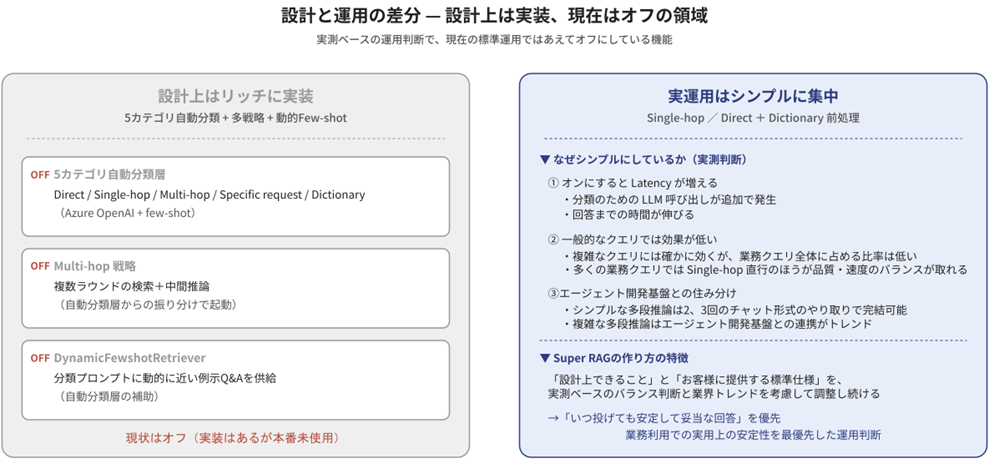
Difference between design and operation
From a design perspective, the question is Direct / Single-hop / Multi-hop / Specific request / Dictionary A layer is implemented that automatically classifies data into five categories. The structure is such that a few-shot prompt is passed to Azure OpenAI to determine the category, and then the data is distributed to a multi-hop strategy or similar based on the result.
but,In current standard operation, this automatic classification layer is turned off.I've decided to do that. There are two main reasons.
Based on these measurements, we currently operate with a simple two-category system: Single-hop and Direct.
The design combines multiple rounds of search with intermediate inference. Multi-hop strategyIt has also been implemented.If you don't investigate something first, you won't know what to investigate next.This is the path for asking questions.
However, since the above automatic classification layer is turned off,Although the data was never assigned to the Multi-hop category, and the Multi-hop strategy was not effectively used, the rationale for this decision will be explained later.
As mentioned by name in the 5th installment DynamicFewshotRetrieval—Dynamically retrieve example Q&A pairs that closely match the question."The search engine" is, in terms of design, 5-category automatic classification promptIt is responsible for dynamically supplying the few-shot samples used in the process.
Currently, the automatic classification layer is turned off.DynamicFewshotRetriever is also essentially dormant.That's right. It's included in the design map, but it's not actually called up in the final version.
The reason these three functions are turned off isIt's not because "the functionality is incomplete," but rather, "based on actual measurements and evaluation of trade-offs, a single-hop-centric approach provides the best balance for the current distribution of business queries."This is based on operational judgment.
For business use,Occasionally, they provide in-depth answers to complex questions, but even simple questions are slow and costly.Rather than,No matter when you ask, you'll get a quick and sufficient response.This leads to greater operational reliability. Super RAG prioritizes practical stability and currently uses a single-hop-based configuration as its standard.
The topics we previewed in the first and fifth sessions, including "Automatic Classification of 5 Types," "Selection of 4 Strategies," and "Applications of DynamicFewshotRetriever," are as follows:The Super RAG capability is implemented as a design feature.This is the case. It does not contradict the explanations given up to this point in the article.While exploring what's possible from a design perspective, the standard settings we offer to our customers are selected based on actual measurements to find the best balance.—That's the characteristic of how Super RAG is made.
Here's a point that's often misunderstood. Saying that Super RAG alone doesn't use a multi-hop strategy as standard might lead to the misunderstanding:Multi-stage inference can't do anything.It might sound like "but",That's not actually the case..
There is a gradient of difficulty in multi-step reasoning for business questions. For example, you might ask, "What product B satisfies condition A?" and then, after seeing the answer, ask, "So, what is the warranty period and return policy for product B?"2-3 step linear reasoningIf the user asks the next question based on the results in a dialogue format,It is essentially achieved through repeated single-hop maneuvers.Yes, it works. It's the same as how we usually use it: exchanging messages on the chat screen.
Super RAG Single-hop is thisThey consistently provide well-supported answers, which serve as a foundation for asking the next question.It is optimized for this purpose. If the user constructs the following query in their mind,Many business-related questions can be addressed through repeated dialogue.—That's the practical reality.
On the other hand, the following types of questions are too time-consuming to ask in a dialogue format.
These types of structures are not practical for users to assemble manually, step by step, via chat.Automated flow controlThis is necessary. This is what I will introduce next.Design for division of labor with agent development platformThis is the area where it becomes effective.
Here,The decision to focus on single-hop technology aligns well with industry trends.Since 2025, the development infrastructure for AI agents—Dify, LangGraph, LangChain Agents, and various workflow platforms—has rapidly expanded. These tools are,Build business workflows by combining multi-step reasoning and tool invocations.This is a product line whose main business is [this].
In this situation, if Super RAG were to try to handle multi-hop inference orchestration on its own,The specialized agent infrastructure and functions overlap, resulting in both being mediocre.It could turn out to be that way. Rather,Super RAG will focus on understanding knowledge sources and maximizing search quality, while automated multi-stage inference will be handled by the agent development platform.This division of labor design is more rational in terms of both the overall quality and operability of the customer's system.
As an example,The Dify expense review workflow, which we introduced in the second installment.Remember that configuration? In that configuration, Dify handled the multi-step reasoning process of "decomposing the application content → referencing external web information → reviewing and deciding," while Super RAG focused on a single step: "providing accounting regulations and account lists via chunk search." This is exactly like that,This section presents good examples of division of labor design.That's right. At the time, I introduced it as an example of an embedded pattern called "Pattern 2 (Search-focused)," but in reality... Solving multi-hop needs with an agent-based infrastructure and a Super RAG combination.This can be reinterpreted as a typical example.
Chapter III, "Visualizing the Content," concludes with its three main pillars (extraction, search, and response strategies). Finally, I will summarize once again how these three layers come together.
As introduced in the fourth installmentChunking according to the properties of the material(For FAQs only, dictionaries only, PowerPoint slides only, etc.) The Dictionary preprocessing and Multimodal Generation described in this article arePrerequisites for subtracting meaningful unitsIt had become like that.
As introduced in the 5th installmentHybrid search + reranking: a two-stage filtering process.The Single-hop strategy described in this article isPrerequisites for receiving appropriate evidence for a question in one goThis is the case. The reason why Super RAG can achieve such a high level of reliability in single-hop searches is precisely because the upstream search quality is not compromised.
And in this articleAnswer StrategyThe materials prepared by the upstreamThe final step involves structuring the questions appropriately and maximizing quality through three techniques (Dictionary, Inline Citation, and Multimodal).is.
In other words,Extraction has a ceiling / Search is a one-time use / Answer strategy is selection and quality refinementThis three-tiered structure allows each layer to effectively utilize the work done in the preceding layer, ultimately building up the quality of the final response.Only when all three layers work together consistently does RAG become a viable solution for business use.That is the core of the precision design of Super RAG.
So far, we have introduced the Super RAG response strategy and three techniques that support response quality.How can we measure the quality of the responses we receive from AI in our work?You might be thinking, "What does that mean?" To look at this from a business perspective,5-point checklist for answer qualityWe have prepared this for you.
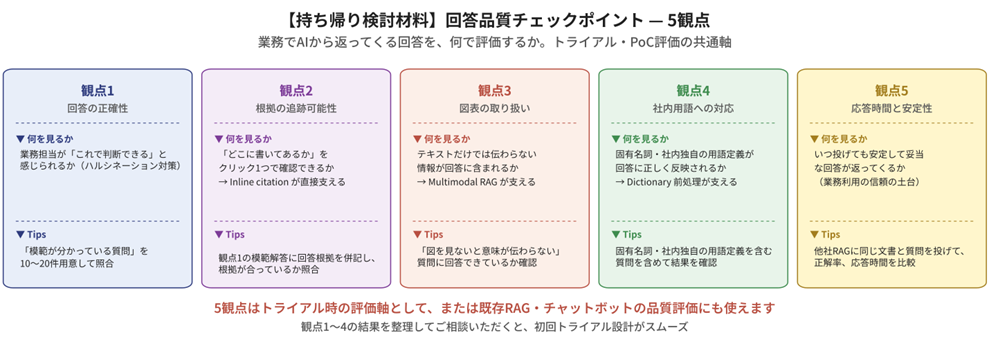
Response Quality Checklist
This is a common perspective that can be used during trials, PoC evaluations, or even for evaluating the quality of existing RAGs and chatbots.
Perspective 1: Accuracy of the answer — Does the person in charge of the work feel that they can make a decision based on this?
The answer is not only factually correct,Can the person in charge of operations use this information with confidence as a basis for decision-making?We will examine the following three points: whether the evidence found through the search is correctly reflected in the answer, whether contradictory information has been arbitrarily added (hallucination), and whether the scope of the cited evidence is appropriate.
TipsIt's most reliable to prepare 10 to 20 questions for which you already know the correct answer and then compare them to the correct answer.
Perspective 2: Traceability of evidence — Can you check "where it's written" with a single click?
In response to the answer,What is the source of this information, and in which document and section?A system is needed that allows the person in charge of the work to check this themselves. Inline citation highlight This directly supports this viewpoint. Sentences within the answer are numbered, and clicking on them jumps to the relevant chunk, and you can even trace back to the corresponding section in the original file—thisDesign that allows you to reach the evidence without hassle.This is the minimum requirement for integrating AI into business operations.
TipsDuring the trial using actual data, you can have the person in charge of operations confirm whether "the basis for this answer is correct," or you can compare it with the basis attached to the model answer in Perspective 1 to confirm it, which will help you understand the necessity of traceability.
Perspective 3: Handling of Figures and Graphs — Does the answer include information that cannot be conveyed through text alone?
Business documents include:Information that cannot be conveyed through text aloneThere are a large number of (flowcharts, organizational charts, graphs, reports with photos, circuit diagrams, etc.). If the answer comes back in text only, it means that half of the evidence is missing. Super RAG Multimodal RAG Generation This system allows you to pass supporting charts and graphs as images to LLM and have them reflected in your response.
Tips: In our company documents,Information whose meaning cannot be conveyed without looking at the diagram.By taking stock of how much of "[this]" is included, you can see where Multimodal is effective.
Perspective 4: Handling of internal company terminology — Are proprietary abbreviations and industry-specific terms correctly reflected in the answers?
If "ROI" refers to "Sales ROI" within a company, or if abbreviations like "PRTR" and "KYT" are commonly used in an industry, the AI will understand these.Please answer based on an understanding of the meaning within the company and industry.It is necessary. Super RAG Dictionary preprocessing This feature works automatically once you register your glossary. It can also be used to normalize confusing synonyms (for example, Super RAG and superlag).
TipsPlease list 10-20 company-specific abbreviations and industry terms, register them in the dictionary, and then test whether the system correctly handles them in the response.
Perspective 5: Response Time and Stability — Can you consistently get a reasonable response no matter when you submit a request?
For business use:Designed to allocate resources to answering a small number of complex questions.Rather than "to the average question of the majority"You will receive a stable, fast, and low-cost response.This leads to greater operational reliability. The fact that Super RAG has chosen a configuration primarily based on single-hop connections is also a result of practical testing that prioritizes this stability.
TipsThe key to evaluation is to submit the same registration data and questions to different RAG systems and observe the variability in response quality and response time. In particular, the Super RAG system is designed to be advantageous when registering large amounts of data.
These five perspectives are,Evaluation criteria when using real data in our company's trials.It can also be used as such. If you organize and communicate the results from perspectives 1 to 4, it will make designing what to try in the initial trial much smoother.Please use the contact form at the end of the article.Please feel free to contact us for advice.
From the next installment (the 7th installment), we will begin Chapter IV, "What is Happening on the Ground." Use Case Example 1: Utilization of Manufacturing and Technical Documentation We will now present the three pillars (extraction, search, and answer strategies) that support the accuracy of Super RAG.How does it function in the specific work environment of manufacturing technical documentation?We will present these cases anonymously.
especially,"Extract past accident and near-miss incidents from work plans.This article will discuss how to build a "document vs. document" search pipeline using an API, and how the three techniques discussed in this article—document structure preservation (Part 4), hybrid search (Part 5)—work together and are effective, along with specific business questions.
The Super RAG answer strategy has a rich set of options in terms of design,In practical use, the focus is on two simple classifications: Single-hop and Direct.It is working as follows: Dictionary preprocessing refines internally specific expressions, inline citation highlighting allows for tracking the basis of answers at the sentence level, and multimodal RAG generation reflects charts and graphs as images in the answers.Three tipsHowever, this simple strategic structure is transformed into a response quality that can withstand business use.
The areas that are implemented in the design but are currently disabled (5-category automatic classification layer, Multi-hop strategy, DynamicFewshotRetriever) are based on actual benchmark results from our internal benchmarks.After evaluating the trade-off between latency and accuracy, we found that for typical business queries, a single-hop approach offers a better balance.This is based on the operational decision that "The design capabilities and the standard operations we provide to our customers are continuously aligned based on actual measurements."—This is the characteristic of how Super RAG is made."
Questions requiring multi-step inference orchestration, considering current trends,Super RAG is responsible for understanding the knowledge source and search quality, while the agent development platform (Dify, LangGraph, etc.) is responsible for building the inference.--We recommend this division of labor design. Super RAG is "Focus on mastering your area of expertise.The message of this article is "product." If you're wondering "how well can our business questions be answered with a standard Super RAG operation?",Please feel free to contact us using the inquiry form at the end of the article.You can compare the results by running your own data through free or paid trials.
<Articles in this series>